You squat and your hips pinch. You run and the same knee keeps flaring up. You sit at a desk all week, hit the gym on weekends, and wonder why your back always tightens up after deadlifts. In cases like that, asking what does a movement assessment involve is the right question - because pain rarely tells the whole story by itself.
A movement assessment is not just someone watching you bend forward and calling it a day. It is a structured way to understand how your body moves, where it compensates, what aggravates your symptoms, and what might be holding you back from training, working, or living normally. For active adults, athletes, and busy professionals, that matters. If the only goal is short-term relief, you may feel better for a few days. If the goal is lasting progress, the assessment has to go deeper.
What does a movement assessment involve in rehab care?
At its core, a movement assessment involves three things: understanding your story, testing how your body currently functions, and using that information to build a plan that actually fits your life.
The first part is the conversation. A good clinician wants to know more than where it hurts. They want to know when it started, what makes it worse, what makes it better, what training or work demands you have, what you have already tried, and what you want to get back to. A runner dealing with hip pain, a parent with neck tension, and a lifter with shoulder pain may all describe pain differently, but the real driver of the plan is how that pain affects their goals.
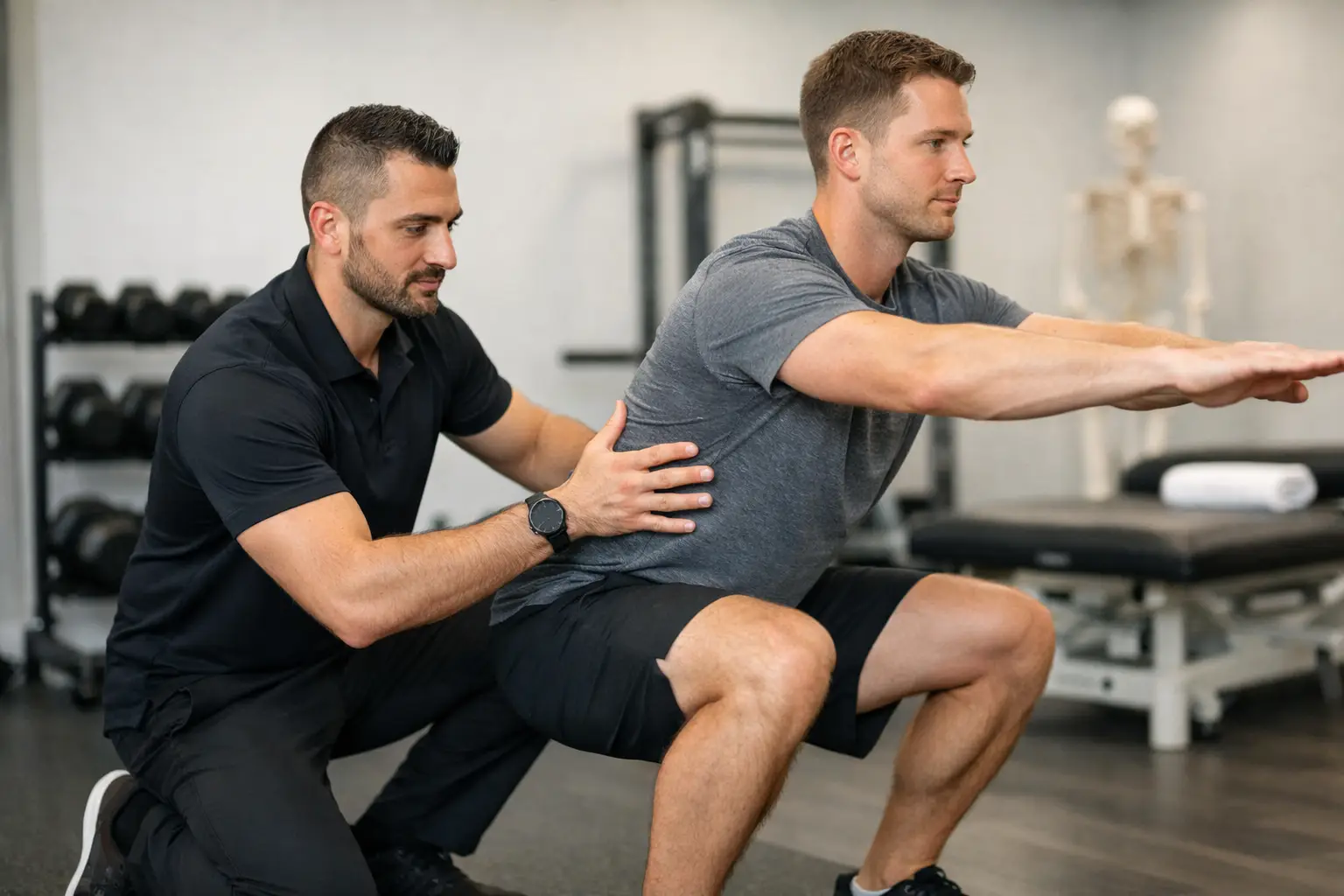
The second part is the physical assessment. This is where movement quality, mobility, control, strength, and symptom response start to come into focus. Depending on the issue, you may be asked to squat, hinge, lunge, reach, rotate, balance, press, or perform a sport- or task-specific movement. If your issue is more everyday than athletic, the focus may be on walking, stairs, sitting, standing, or getting overhead comfortably.
The third part is clinical decision-making. This is the piece people often miss. A movement assessment is not useful because it generates a long list of imperfections. It is useful because it helps narrow down which findings matter, which ones do not, and what to do next.
It is not about finding a "perfect" body
A lot of people worry they will fail a movement assessment. That is not how it works.
The goal is not to prove that your posture is bad or that one side of your body is broken. Everyone has asymmetries, movement habits, old injuries, and strengths and weaknesses. The real question is whether those patterns are relevant to your current symptoms and goals.
For example, limited ankle mobility may matter a lot for someone dealing with knee pain during squats or running. It may matter much less for someone whose main issue is neck pain during long desk days. Tight hips, weak glutes, poor core control - these are common phrases, but they only matter if they actually connect to your presentation. Good assessment is specific, not generic.
What a clinician is actually looking for
When people hear the term movement assessment, they often picture a checklist. In reality, it is more of an investigation.
A clinician is looking at how you load joints, how you control positions, whether certain movements reproduce symptoms, and whether other movements reduce them. They may compare side to side, check active and passive range of motion, test strength in specific muscle groups, and look at how well you coordinate multiple areas together.
They are also paying attention to the difference between mobility and control. Sometimes a joint does not move well because the surrounding tissue is stiff. Other times the joint has enough range, but you do not control it well under load or speed. That distinction changes the plan. One person may need mobility work and symptom relief to get moving. Another may need progressive strengthening and better exposure to the movements they keep avoiding.
Pain behaviour matters too. Does pain show up right away, or only after repeated reps? Is it sharp, stiff, unstable, or more like fatigue? Does it happen during training, the next day, or after sitting too long? These details help shape treatment and rehab far more than a vague label ever could.
What does a movement assessment involve for treatment planning?
This is where the assessment becomes practical.
If the findings suggest that your pain is being driven by limited mobility, irritated tissue, poor tolerance to load, and a sudden jump in activity, then the plan should reflect that. If your issue looks more like deconditioning, movement avoidance, lack of strength, or poor recovery capacity, that changes things too.
A strong treatment plan usually combines the right tools at the right time. That may include hands-on care, chiropractic treatment, soft tissue therapy, joint mobilization or adjustments when appropriate, shockwave therapy, Class IV laser therapy, cupping, mobility drills, and strength-based rehab. But those tools are not the plan by themselves. They support the plan.
That distinction matters. If your shoulder is painful overhead, an adjustment or soft tissue treatment may help calm things down and improve movement in the short term. But if your shoulder also lacks strength, control, or tolerance for pressing and pulling, the long-term answer is not more passive care alone. It is progressive rehab that builds capacity so you can get back to training with confidence.
That is one reason movement assessment is such a big part of rehab-focused care. It helps match treatment to the problem instead of applying the same approach to everyone.
Why this matters if you have already tried other care
A lot of active people are not starting from scratch. They have already rested, stretched, foam rolled, watched exercise videos, gotten massage, had adjustments, or done a sheet of generic rehab exercises. Sometimes those things help a bit. Sometimes they help until training picks up again.
Often the missing piece is not effort. It is clarity.
If nobody has looked at how you move, how your symptoms respond to load, what your weekly demands are, and what your actual return goal looks like, treatment can become reactive. You chase flare-ups instead of building a clear progression. That is frustrating, especially if you are motivated and doing your best.
A detailed assessment can help answer questions like: Are you under-loading the area and losing capacity? Are you overloading it too quickly? Are you moving around the painful area because of stiffness, fear, or habit? Are you trying to return to sport before your strength, control, or conditioning are ready? Those answers shape better rehab.
Assessment should lead to action
A movement assessment should not leave you with a pile of technical terms and no next step.
You should come away understanding what seems to be contributing to the issue, what movements are currently sensitive, what you can still do safely, and what the plan is to move forward. Sometimes that plan starts with settling down pain and restoring basic movement. Sometimes it moves quickly into loading, strength work, and return-to-performance progressions. It depends on the person, the condition, and the goal.
For someone training regularly, rehab should eventually look more like training again. For a desk worker with recurring neck and back pain, rehab may focus on mobility, posture variation, tolerance to work demands, and general strength. For a runner, golfer, or lifter, the later stages should reflect the actual movements and forces of the activity they want to return to.
That is also why gym space matters in a rehab setting. There is a big difference between doing clamshells forever and actually progressing toward squats, carries, hinges, presses, split squats, or sport-specific movement when the time is right.
A good assessment is individual, not scripted
Two people can have the same pain location and need very different plans.
One person with low back pain may need reassurance, mobility work, and a gradual return to deadlifting. Another may need more trunk endurance, better hip control, and adjustments to volume and recovery. One runner with knee pain may need calf strength and load management. Another may need better hip control and a slower return to speed work.
That is why individualized care matters. At Ground Up in Hamilton, movement assessment is part of a bigger rehab model that combines chiropractic care, hands-on treatment, rehab exercise, and performance-based progressions under one roof. The point is not to label you as fragile. The point is to figure out what is limiting you and build a plan that helps you return stronger and with more confidence.
If you are wondering whether your issue needs rest, treatment, rehab, or a smarter return to activity, a movement assessment is often the best place to start. The value is not just in finding what hurts. It is in understanding how to move forward with a plan that makes sense for your body, your goals, and your life.
