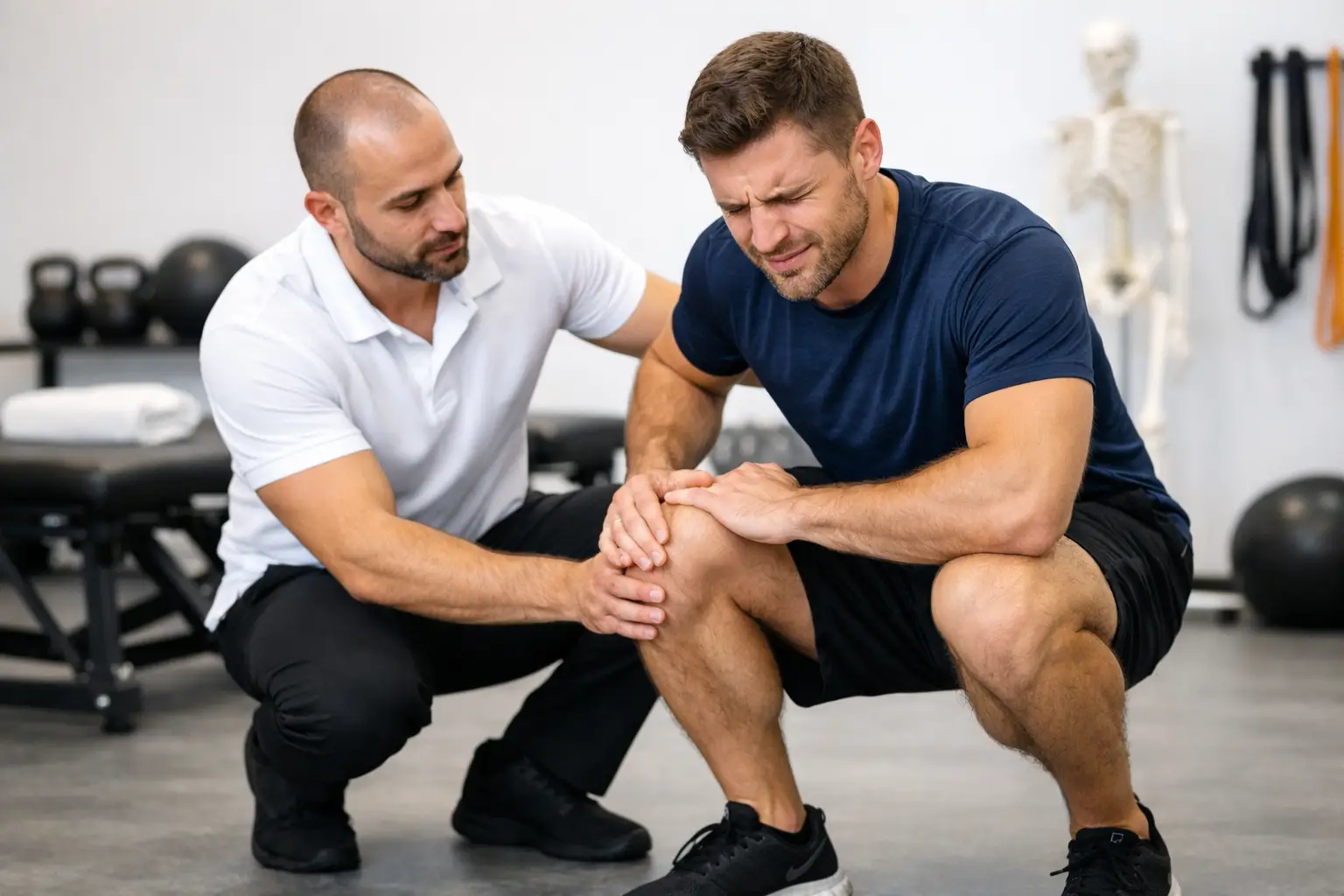
You get to the bottom of a squat and something feels off. Maybe it is a pinch in the front of the hip, pressure in the knee, tightness through the low back, or an ankle that just will not let you get depth without compensation. If you are asking what causes pain during squats, the short answer is this: usually not one single thing. Squat pain tends to come from a mix of mobility limits, strength deficits, technique issues, training load, and irritation of tissues that are not tolerating the demand well right now.
That matters because the wrong response is usually to either push through blindly or stop squatting altogether. Neither is a great long-term plan. Most people do better when they figure out which part of the movement is creating the problem, why their body is compensating, and how to rebuild tolerance so squats feel strong again.
What causes pain during squats most often?
Squat pain is often treated like a diagnosis, but it is really just a symptom. The more useful question is where the pain shows up, when it shows up, and what changes it.
For some people, the issue is limited ankle motion. If the ankle does not move well into dorsiflexion, the body has to find depth somewhere else. That can mean the heels lift, the knees cave, the torso folds too far forward, or the low back takes on more stress than it should. For others, the problem is not mobility at all. They may have the range, but not the control or strength to use it under load.
Hip mobility can also play a role, especially if the front of the hip feels pinchy at the bottom of the squat. Sometimes that is related to stance width, foot angle, or depth that does not match the person’s anatomy. Sometimes the hips are simply being asked to do more than they can control right now.
Knee pain during squats is another common complaint, but that does not automatically mean squats are bad for your knees. It often means the knee is being asked to tolerate a load it is not prepared for. That could be from rapid training increases, poor load management, weakness through the quads and hips, reduced ankle mobility, or a pattern that shifts force into irritated tissue.
Low back pain during squats can come from a similar story. Sometimes the issue is bracing. Sometimes it is fatigue. Sometimes it is limited hip mobility leading to motion being borrowed from the lumbar spine. And sometimes it is a back that has become sensitive after too much volume, too much load, or not enough recovery.
Pain during squats is not always about bad form
A lot of people have been told their squat pain is caused by “bad form.” That can be part of the picture, but it is often oversimplified.
There is no single perfect squat that fits every body. Femur length, hip anatomy, ankle mobility, training history, and goals all influence what a strong squat should look like. A powerlifter squatting low bar with a wider stance will not move the same way as someone doing front squats for general fitness, and neither is automatically wrong.
What matters more is whether your current squat strategy matches your body’s capacity. A form change might help, but if the real issue is tissue irritation, weakness, poor recovery, or a sudden jump in volume, a cue alone will not solve it.
That is why a proper assessment matters. You want to know whether pain is being driven by mechanics, mobility, strength, load, or some combination of all of them.
Common reasons squats start hurting
In practice, squat pain usually falls into a few broad categories.
The first is load management. If you recently increased weight, volume, frequency, tempo work, or accessory training, your body may simply be reacting to more stress than it can recover from. This is especially common when someone returns to training after time off and tries to pick up where they left off.
The second is movement restriction. Limited ankle, hip, or thoracic mobility can change how the squat is distributed through the body. That does not mean you need perfect mobility everywhere. It means the ranges you need for your style of squat should be available and usable.
The third is strength or control deficits. You may be able to hit good positions unloaded, but once the bar goes on your back, the pattern changes. Knees collapse, weight shifts forward, depth disappears, or the torso loses position. That often points to a capacity issue more than a flexibility problem.
The fourth is tissue sensitivity. Tendons, joints, muscles, and surrounding structures can all become irritated. In those cases, the squat itself may not be the enemy. The dose may just need to change while capacity is built back up.
Finally, there is programming mismatch. If your squat variation does not suit your current body, goals, or symptoms, it may keep flaring things up. A temporary change to box squats, goblet squats, heel-elevated squats, tempo work, or split squat progressions can keep you training without feeding the problem.
Where the pain is changes the conversation
Pain at the front of the knee often points toward patellofemoral irritation, quad tendon irritation, patellar tendon sensitivity, or a knee that is simply overloaded. Pain on the inside or outside of the knee may involve different tissues, but the bigger point is that location helps guide the assessment.
Pain in the front of the hip often shows up at deeper ranges and may improve with a stance adjustment, different depth target, or better control through the trunk and pelvis. That does not mean everyone with hip pinching has the same issue. It means the setup and movement strategy need a closer look.
Pain in the low back often shows up when fatigue increases, bracing breaks down, or the hips stop contributing enough. Some lifters get symptoms only on heavier sets. Others feel it with bodyweight squats because the back is already irritated and sensitive.
Ankle pain during squats may be related to mobility restrictions, prior injury, stiffness through the calf, or a loading strategy that the ankle does not tolerate well. Again, this is where guessing tends to waste time.
How to tell if you should modify, not quit
If pain is sharp, worsening, associated with significant swelling, giving way, numbness, or symptoms that do not fit a normal training response, it is worth getting assessed by a qualified healthcare professional.
If the pain is more of an ache, pinch, or manageable discomfort that appears only during certain squat variations or loads, there is often room to modify rather than fully stop. That might mean reducing depth, lowering load, changing bar position, slowing tempo, adjusting stance, or using a different lower body pattern while the irritated area settles down.
This is where many active adults get stuck. They rest until things calm down, go back to the same squat the same way, and the pain returns. The missing piece is usually a plan to build back capacity, not just wait for symptoms to disappear.
What actually helps fix squat pain
The best approach depends on what is driving it, but the goal is usually the same: reduce irritation, improve movement options, and build strength in a way the body can tolerate.
That might include hands-on care to calm symptoms and improve short-term motion, but passive treatment alone is rarely enough if the squat keeps exposing the same limitation. Joint mobilization, soft tissue work, chiropractic treatment, massage therapy, cupping, shockwave therapy, or Class IV laser therapy can all be useful tools when they fit the presentation. They work best as part of a bigger plan, not as a standalone fix.
The longer-lasting piece is rehab that addresses the reason the squat hurts in the first place. That could mean improving ankle dorsiflexion, building quad strength, restoring hip control, teaching better trunk bracing, or progressing squat variations that match your current capacity.
For one person, that might mean heel-elevated goblet squats and calf mobility work. For another, it may mean pausing the barbell back squat for a few weeks and rebuilding with split squats, tempo squats, and progressive loading. For someone else, the answer is not less squatting - it is better recovery, smarter programming, and a return-to-load plan that makes sense.
At Ground Up Chiropractic and Rehab, that is the difference in approach. Instead of only chasing pain, the process looks at how you move, what your training demands are, what tissues are irritated, and what needs to improve so you can get back to lifting with confidence. That may include chiropractic care, physiotherapy, massage therapy, movement assessment, hands-on treatment, and gym-based rehab progressions under one roof.
When an assessment makes sense
If squat pain has been hanging around for more than a couple of weeks, keeps coming back when you reload, or is changing how you train, it is worth getting it looked at. The same goes if you have tried rest, mobility drills, or random online exercises and nothing really sticks.
A good assessment should not just tell you what hurts. It should help explain why your squat is provoking symptoms, what needs to change, and how to keep you moving while you work on it.
You do not need to wait until you cannot squat at all. Often the best time to deal with it is when the pain is still manageable but clearly limiting your progress.
Squats are one of the best tools for building strength and resilience, but they should not feel like a constant negotiation with pain. If your body is giving you a warning sign, listen to it, figure out what is driving it, and use that information to come back stronger instead of just hoping the next warm-up set feels different.
