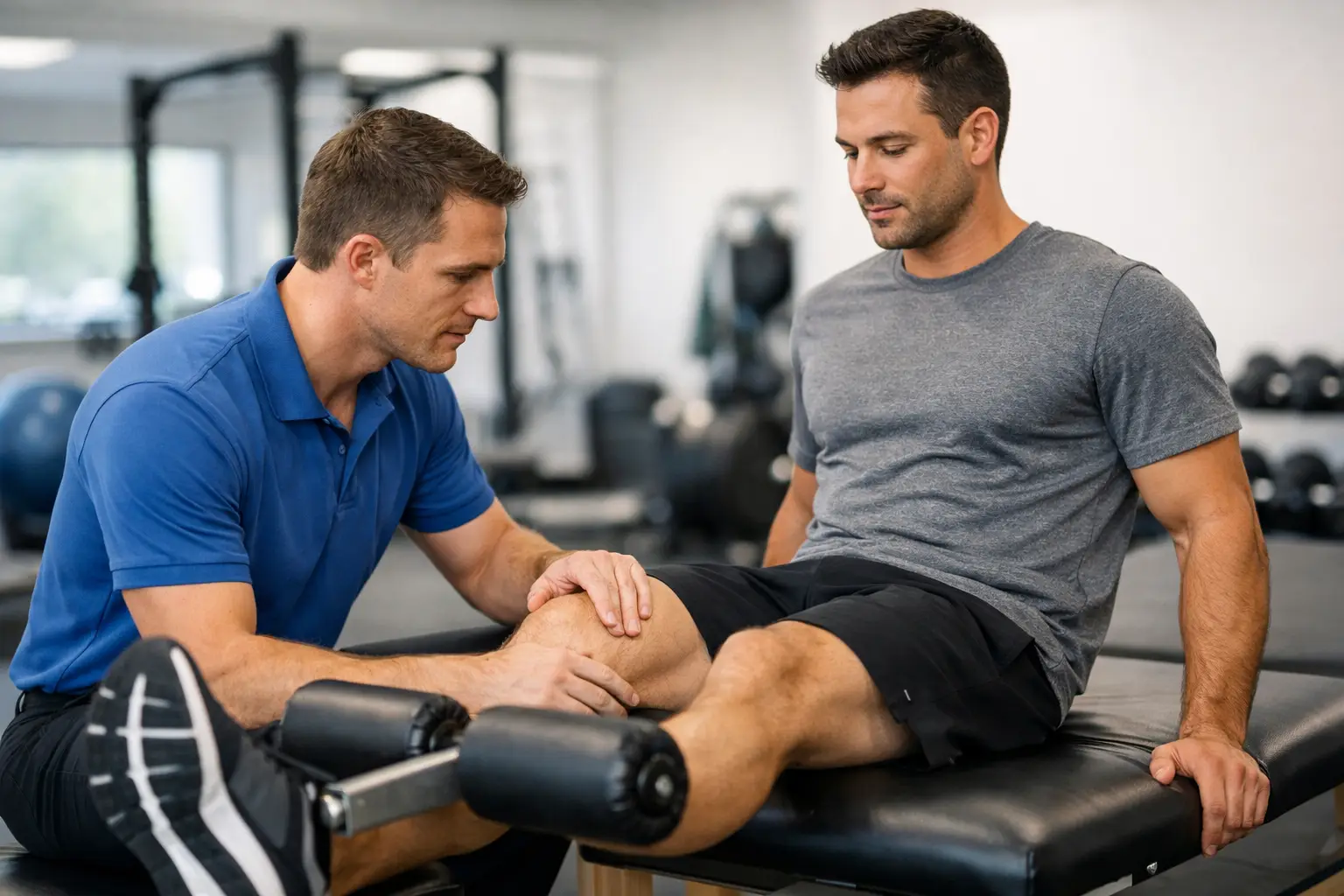
A sore patellar tendon can turn ordinary movements into a negotiation. Stairs hurt, getting up from a chair feels sharp, and a squat, jump, run, or shift at work may become something you brace for. Effective patellar tendon recovery is not usually about finding one treatment that makes the pain disappear. It is about understanding what the tendon can currently tolerate, then building its capacity so you can trust your knee again.
What is the patellar tendon?
The patellar tendon sits at the front of the knee, connecting the kneecap to the shinbone. It works with the quadriceps to straighten your knee and absorb force during activities such as walking downstairs, squatting, running, jumping, landing, and lifting.
When this tendon becomes painful, the issue is often called patellar tendinopathy, sometimes known as jumper's knee. This does not only affect volleyball or basketball players. It is common in runners, weightlifters, CrossFit athletes, people returning to sport after time away, and workers who spend a lot of time climbing, kneeling, lifting, or using stairs.
Patellar tendon pain is commonly felt just below the kneecap. It may be stiff at the start of activity, settle once you warm up, then flare later that day or the next morning. That pattern can be frustrating because it makes it easy to assume you are ready for more than the tendon can handle.
Why patellar tendon recovery can take time
Tendons respond differently than muscles. A muscle may feel sore after a new workout and recover relatively quickly. A tendon often reacts more slowly to a change in load, and it may take 24 hours or longer for an increase in symptoms to become clear.
The problem is not always one dramatic injury. More often, the tendon has been asked to manage more force than it was prepared for. That might mean adding running mileage, returning to basketball, increasing squat volume, changing jobs, training through fatigue, or taking a holiday from exercise and then restarting at full speed.
This does not mean activity caused damage in a simple, linear way. Tendon pain is influenced by training load, recovery, overall strength, movement tolerance, sleep, stress, previous injury, and other health factors. Some people develop symptoms after a clear training change; others cannot point to one obvious trigger.
Rest can reduce irritation, especially during a painful flare-up. But complete rest for too long can leave the tendon less prepared for the demands that caused the problem in the first place. The goal is usually not zero load. It is the right amount of load, progressed at the right time.
Common symptoms and aggravating activities
Patellar tendon symptoms can vary, but common signs include pain or tenderness at the bottom edge of the kneecap, stiffness after sitting, discomfort when going downstairs, and pain with squatting, lunging, jumping, or running. Some people notice a warm-up effect, where the knee feels better during activity but aches more afterward.
Deep knee bending under load is often provocative. Heavy squats, split squats, leg press, jumping drills, sprinting, hill running, and repeated stair climbing all increase demand on the tendon. The specific trigger matters. Someone training for a powerlifting meet may need a different plan than someone who wants to walk the escarpment trails comfortably or keep up with physical demands at work.
Pain at the front of the knee is not automatically patellar tendinopathy. Patellofemoral pain, bursitis, joint irritation, fat pad irritation, or a more significant injury can create overlapping symptoms. A proper assessment helps distinguish likely contributors and prevents a generic exercise plan from missing the mark.
When to seek medical assessment sooner
A sudden pop, marked swelling or bruising, inability to actively straighten the knee, knee instability after trauma, fever, a hot and significantly swollen joint, or calf swelling should be assessed promptly. These symptoms may point to a problem that needs medical investigation rather than a self-managed tendon program.
How a rehab assessment guides the plan
A useful assessment starts beyond the painful spot. It should look at your symptom history, recent workload changes, training goals, previous injuries, and what has or has not helped. The clinician will also assess knee range of motion, quadriceps and hip strength, calf capacity, balance, and how the knee responds to tasks such as squatting, stepping, hopping, or running when appropriate.
The aim is not to identify a single perfect movement fault. Bodies move in different ways, and there is rarely one posture or technique that explains all tendon pain. Instead, assessment helps identify what loads currently aggravate symptoms and which starting exercises are realistic.
Pain response is useful information. Mild discomfort during rehabilitation is often manageable, particularly if it stays controlled and returns to baseline by the next day. Sharp, escalating pain or a clear 24-hour flare suggests the exercise, volume, range, or frequency needs adjustment. This is why blindly following a high-volume online tendon protocol can backfire.
Treatment options that support progress
Hands-on treatment can be helpful when pain, stiffness, or surrounding muscle tension is making it difficult to begin loading confidently. Depending on the assessment, this may include deep soft tissue therapy, instrument-assisted soft tissue therapy such as Graston, cupping, or joint treatment where it is clinically appropriate. These approaches are not intended to physically break up tendon tissue or cure the condition. Their value is often short-term symptom relief or improved movement tolerance, creating a better opportunity to train.
Shockwave therapy and Class IV laser therapy may also be considered for some persistent tendon presentations. They are not replacements for a progressive rehabilitation plan, and results can vary. When used, they should support the larger goal: gradually improving the tendon's ability to handle the activities you care about.
If your knee is highly irritable, temporary changes to training can make a major difference. This may mean reducing jump frequency, limiting deep knee flexion, shortening runs, using a more tolerable squat range, or switching some conditioning work to cycling or other lower-impact options. Modification is not quitting. It is a way to keep moving while reducing repeated aggravation.
Patellar tendon recovery through progressive loading
Progressive loading is the centre of most successful tendon rehabilitation. The starting point depends on pain levels and current capacity, but a plan often moves through several overlapping stages.
Early on, isometric exercises may help some people settle symptoms and regain confidence in loading the quadriceps. These are sustained muscle contractions, such as a wall sit or leg extension hold, performed at a tolerable intensity. They are not mandatory for everyone, but they can be a useful entry point when movement is painful.
The next focus is controlled strength work. Slow resistance exercises such as squats to a tolerable depth, split squats, step-ups, leg press, or knee extensions can build quadriceps capacity. Hip and calf strength may also matter, especially for people whose symptoms are connected to running, jumping, or repeated change of direction.
As strength improves, the program needs to resemble your actual demands. A runner may progress toward faster running, hills, and strides. A basketball player may need landing mechanics, acceleration, deceleration, and repeated jumping. A tradesperson may need loaded carries, step-ups, kneeling tolerance, and stair capacity. Strength is not the finish line if your goal requires power, speed, endurance, or repeated impact.
Progression should be based on more than pain during one session. We also consider the next-day response, quality of movement, strength changes, confidence, and whether you can recover between sessions. Sometimes the right move is adding load; sometimes it is holding steady for a week so the tendon has time to adapt.
A practical approach to returning to training
You do not need to wait until every sensation is gone before rebuilding activity. However, returning to full training too quickly is one of the most common reasons tendon pain keeps cycling.
Start by deciding which activity matters most right now. If you are a recreational runner, that may be a comfortable 5 km. If you lift, it may be squatting without changing your training around your knee. If you work on your feet, it may be making it through a shift without an escalating ache.
Then build around that goal. Keep the exercises that improve strength, reintroduce the aggravating activity in manageable doses, and avoid making several large changes in the same week. Increasing running mileage, adding plyometrics, and pushing heavy leg days simultaneously makes it difficult to know what your knee is responding to.
At Ground Up Rehab in Hamilton, treatment plans for patellar tendon pain combine a thorough assessment, meaningful symptom management where needed, and a clear loading progression. The focus is not on keeping you dependent on passive care. It is on helping you return to training, work, sport, and daily movement with a plan you can understand and carry forward.
If pain below your kneecap has been limiting your squat, run, stairs, or sport, book an assessment. A focused plan can help you stop guessing, load your knee with more confidence, and build toward the activities you want back.
