You do not need a 30-minute pre-lift stretching ritual to squat deeper or catch a cleaner overhead position. Most weightlifters who struggle with stiffness are not dealing with a simple "tight muscle" problem. They are dealing with a mix of mobility restrictions, motor control issues, load tolerance, technique habits, and sometimes pain. That is why mobility training for weightlifters works best when it is specific to the lift, the joint, and the reason the restriction is showing up in the first place.
A lot of lifters have already tried the usual fixes. Foam rolling. Banded distractions. Random hip openers from social media. A few ankle stretches between sets. Sometimes those tools help. Sometimes they do nothing. The difference usually comes down to whether the drill matches the actual problem.
What mobility training for weightlifters should actually do
Good mobility work is not about becoming endlessly flexible. Weightlifters need usable range of motion they can control under load. That means enough ankle dorsiflexion to hit positions in the squat, enough hip motion to move without compensation, enough thoracic extension and shoulder mobility to own the front rack and overhead positions, and enough stability to keep those positions from falling apart when the bar gets heavy.
This is where people often get stuck. They chase range without control, or they chase treatment without changing the movement pattern that keeps irritating things. If your overhead position collapses because your upper back is stiff, your lats are limiting range, and you cannot control upward rotation well, a generic shoulder stretch is probably not going to solve it.
Mobility has to be connected to performance. If the goal is a better snatch, cleaner front rack, or more comfortable squat, the mobility work should improve that outcome in a measurable way.
The big mistake: treating all stiffness the same
"Tight" is one of the most overused words in the gym. Sometimes a muscle feels tight because it is actually stiff. Sometimes it feels tight because a joint is not moving well. Sometimes it is a protective response because the body does not feel stable or strong in that position. And sometimes pain changes the way you move, which makes everything feel restricted.
That matters because the solution changes depending on the driver. A lifter with limited ankle motion may need joint mobilization, calf work, and loaded squat variations. Another lifter may have enough ankle range on the table but lose it as soon as they squat because they cannot control the position. Those are not the same problem.
The same goes for front rack and overhead positions. One athlete may need thoracic mobility and soft tissue work through the lats and triceps. Another may need to improve ribcage position, scapular control, and how they receive the bar. Mobility without assessment turns into guesswork fast.
The joints that matter most in Olympic lifting
For most weightlifters, the biggest bottlenecks show up at the ankles, hips, thoracic spine, shoulders, and wrists. But the answer is not to attack every area equally.
Ankles matter because if you cannot translate the knee forward well in the squat, the body has to find depth somewhere else. That may look like heels lifting, feet turning out excessively, the torso collapsing forward, or the hips shifting. If you are forcing depth around an ankle limitation, the lift usually feels unstable before it feels strong.
Hips matter because you need enough flexion, rotation, and control to move into deep squat positions without pinching, shifting, or losing tension. But not every deep hip pinch is a "mobility issue." In some cases, stance, pelvic position, and load management matter just as much.
Thoracic spine and shoulders matter because front rack and overhead positions demand a lot of coordinated movement. If the upper back stays rigid, the shoulders often take the hit. If the shoulder moves a lot but the scapula and trunk do not support it well, the position may look available but still feel weak or irritated.
Wrists also deserve more respect than they usually get. A front rack that dumps into the wrists is not always a wrist problem, but if wrist extension is limited, it can absolutely become part of the issue.
How to build a mobility routine that is worth your time
The best mobility routine is usually short, targeted, and repeated often enough to matter. For most lifters, 8 to 15 minutes before training is plenty if the drills are chosen well.
Start with the lift that feels limited. If your front squat is the problem, do not begin with a random full-body mobility circuit. Start with the positions and joints that are blocking the front squat. That may mean ankle mobilizations, a squat hold with breathing, front rack positional work, and then goblet squats or tempo front squats to integrate the new range.
This is where a lot of mobility routines fall apart. People stop at passive work. They stretch, mobilize, or get hands-on treatment, then expect the body to keep the change. Usually, you need to reinforce the new range with active movement and loaded patterning.
A practical sequence looks like this: open the range, control the range, then use the range. That might mean a mobility drill, followed by an isometric or controlled articular movement, followed by a lift variation that teaches the body how to own the new position.
Mobility work should change across the training week
Not every session needs the same amount of mobility work. If you are lifting well, moving well, and not dealing with pain, your prep can stay simple. On heavier squat or clean days, you may need a little more ankle, hip, and front rack work. On snatch days, overhead mobility and thoracic movement may deserve more attention.
There is also a difference between warm-up mobility and longer-term mobility development. Warm-up work should help you train that day. Longer-term mobility work is where you address the restrictions that keep coming back.
That longer-term work often belongs outside the main lifting session. If you have been forcing around the same overhead or squat limitation for months, you may need a more structured plan that includes mobility drills, strength work in end ranges, movement retraining, and better load management.
When pain changes the equation
If mobility restrictions are paired with pain, the answer is rarely to push harder into the painful range and hope it loosens up. Pain can change muscle tone, coordination, confidence, and how much force your body is willing to produce. That is one reason lifters can feel "tight everywhere" during a flare-up.
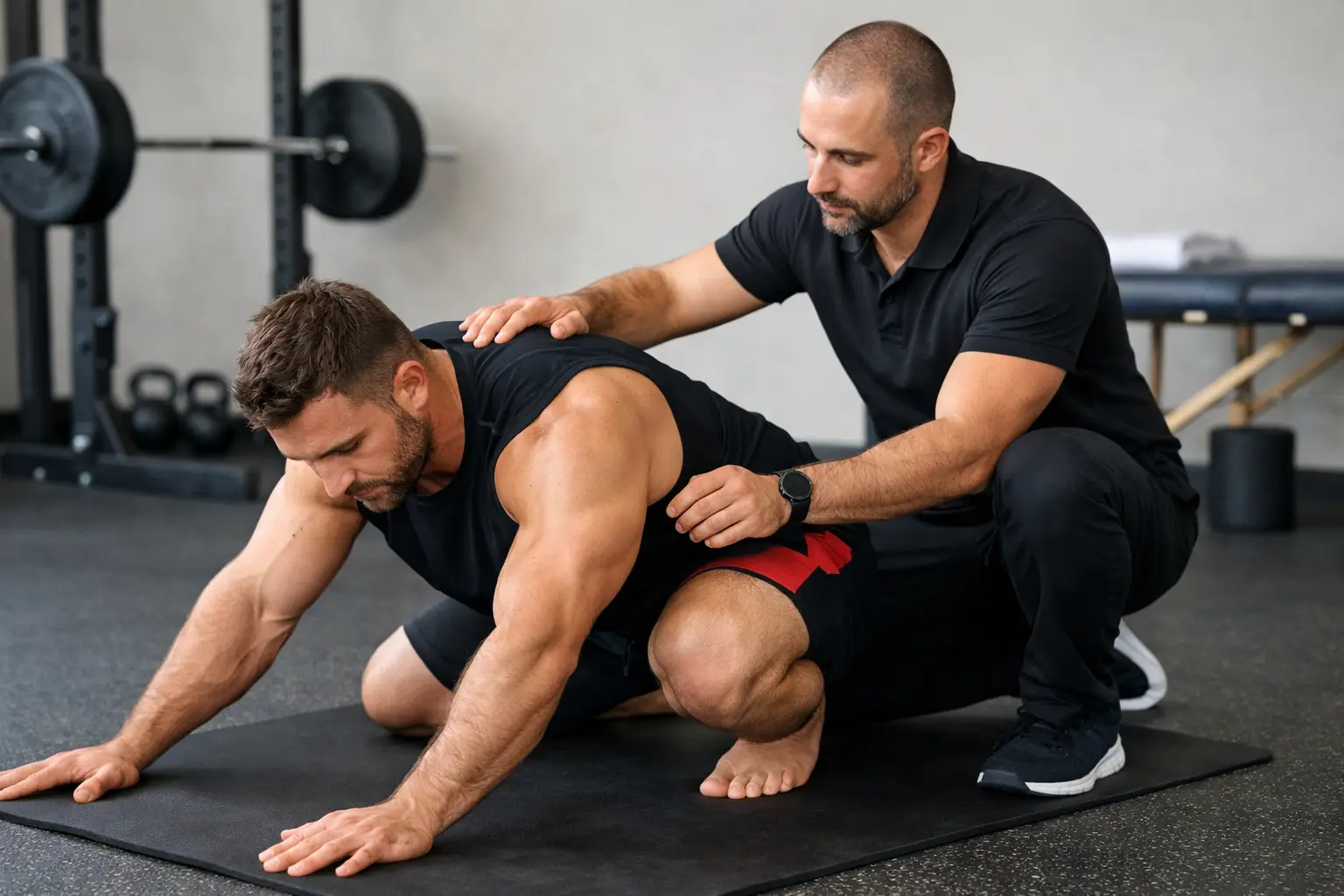
This is where a more complete rehab and performance approach matters. Hands-on care, chiropractic treatment, joint mobilization, soft tissue therapy, cupping, shockwave therapy, or Class IV laser therapy may help calm symptoms and improve tolerance when they fit the case. But those tools work best when they are part of a bigger plan that also includes movement assessment, mobility work, progressive strengthening, and return-to-lifting progressions.
At Ground Up Performance & Rehab in Hamilton, that is the difference in approach. The goal is not just to loosen something up for a day. It is to figure out what is driving the limitation, improve how you move, build strength in the positions you need, and help you return to training with more confidence.
Why strength is part of mobility training for weightlifters
A position you cannot control is not really a usable position. That is why the strongest mobility plans usually include tempo work, pauses, carries, isometrics, and lift variations that challenge control.
If your ankles improve but you still fold in the bottom of a clean, you likely need more than mobility. If your shoulders move better overhead but you still cannot stabilize a snatch balance or overhead squat, strength and coordination are part of the story.
This is good news, because weightlifters usually respond well to strength-based rehab. You do not need endless passive care. You need the right combination of symptom management, movement restoration, and progressive loading.
Signs your mobility plan needs an upgrade
If your mobility work only helps for a few minutes, if the same joints always feel blocked, or if your positions disappear as soon as the load gets heavy, your current plan is probably too generic. The same is true if you keep stretching an area that feels tight but never actually tests limited.
Another clue is when mobility drills improve one lift but aggravate another. That usually means the issue is more specific than a blanket flexibility problem. It may be a technique issue, a recovery issue, or a sign that one area is compensating for another.
A proper assessment can help sort that out. For lifters, that should include more than a quick table exam. It should look at joint motion, movement quality, symptom behaviour, lifting positions, training demands, and what happens under load.
If you have been stuck in the cycle of temporary relief, that does not mean mobility work is pointless. It usually means the plan has been incomplete.
Mobility training for weightlifters should make your lifts feel cleaner, stronger, and more repeatable. If it is not doing that, it may be time to stop collecting random drills and start using a plan that actually matches how you train.
