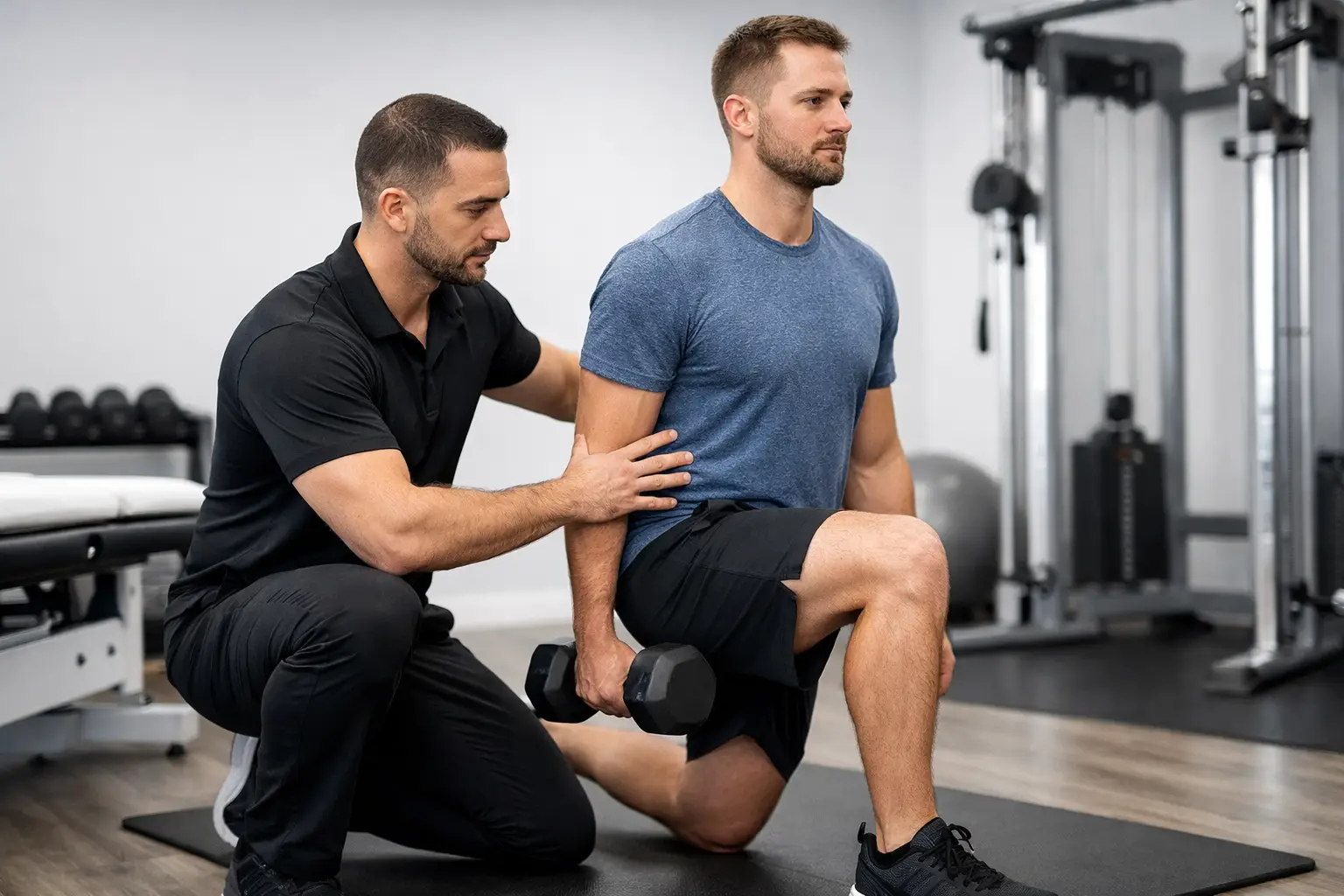
You tweak your shoulder on pressing day, your knee starts barking during squats, or your back tightens up halfway through a deadlift warm-up. The usual reaction is either to push through and hope for the best or stop everything and wait for the pain to disappear. Neither option is always the right one. If you want to know how to train around pain, the goal is usually not complete rest or blind toughness. It is finding a smart way to keep moving, reduce aggravation, and rebuild capacity.
That matters because pain does not always mean damage, and a flare-up does not automatically mean you need to shut training down. At the same time, not every painful movement should be forced. The real skill is knowing what to modify, what to keep, and when to get assessed.
What training around pain actually means
Training around pain does not mean ignoring symptoms. It means adjusting your training so your body can tolerate it while the irritated area settles down and gets stronger.
For some people, that means changing exercise selection. For others, it means reducing load, shortening range of motion, slowing tempo, or cutting total volume for a few weeks. You are still training, but with a plan instead of guesswork.
This is where many active adults get stuck. They rest until they feel a bit better, then jump right back into the same workload that irritated things in the first place. A few good days later, the pain returns. That cycle is frustrating because it feels random, but it usually is not. Your body often needs a better progression, not just more time off.
How to train around pain without making it worse
A good starting point is to separate tolerable discomfort from pain that keeps escalating. Mild symptoms during training are not always a dealbreaker, especially if they stay manageable, settle quickly after the session, and do not spike the next day. Pain that gets sharper with every set, changes your technique significantly, or lingers and worsens afterward is a different story.
A simple question helps here: can you train in a way that keeps symptoms controlled during the workout and acceptable over the next 24 hours? If yes, you may have a workable entry point. If no, the plan needs to change.
That change might be smaller than you think. A lifter with front-of-knee pain may tolerate a box squat, split squat, sled push, or tempo goblet squat better than heavy back squats. Someone with shoulder pain during barbell bench press may do better with dumbbells, a neutral grip, push-ups to an elevated surface, or landmine press variations. If deadlifts light up your back, trap bar pulls from blocks or Romanian deadlifts with a lighter load may be more manageable.
The point is not to find a forever workaround. The point is to keep some training effect while you calm things down and build back up.
Start with the least disruptive change
Most people change too much or not enough. They either scrap everything or stubbornly keep the exact same plan. A better approach is to make the smallest change that allows progress.
Start by adjusting one variable at a time. Reduce load first. If that is not enough, reduce range of motion. If that still does not help, swap the exercise. You can also change tempo, stance, grip, setup, or equipment before writing off the movement completely.
This matters because the movement itself is not always the problem. Sometimes it is the dosage. A squat is not inherently bad for your knees. A press is not inherently bad for your shoulder. But a certain variation, at a certain load, with a certain volume, at your current tolerance level, might be too much right now.
That is a very different message than saying your body is broken.
Pain during training is information, not a character test
One of the biggest mistakes active people make is treating pain like a challenge to overcome. If you are motivated, disciplined, and used to training hard, that mindset can backfire fast.
Pain is feedback. It tells you what your system is tolerating today. That does not mean it is perfectly precise, and it does not mean every painful rep is harmful. It does mean your plan should respond to it.
There is a difference between training hard and training recklessly. Smart athletes know how to adjust without feeling like they are losing momentum.
Keep the body part involved when possible
If an area is irritated, completely unloading it for too long can make returning harder. In many cases, the better move is to keep it involved at a tolerable level.
That may look like isometrics for a painful tendon, lighter single-leg work for an irritated knee, controlled pressing at reduced range for a sore shoulder, or trunk work that builds tolerance without provoking your back. The exact exercise matters less than the principle. Keep some exposure. Build confidence. Gradually increase demand.
This is one reason passive care alone often falls short. Hands-on treatment, chiropractic care, soft tissue work, joint mobilization, massage therapy, shockwave therapy, Class IV laser therapy, and cupping can all have a role when appropriate, especially if they help reduce irritation and improve movement. But if you stop there and never rebuild strength, control, and load tolerance, the problem often comes back as soon as training intensity returns.
Train what does not hurt, but do not hide forever
When pain shows up, people often default to a long list of “safe” exercises and avoid the aggravated pattern for months. That can keep you active, which is good. It can also turn into avoidance, which is not.
If squatting hurts and you only do machine work forever, you may stay busy without actually solving the gap. If overhead work hurts and you avoid lifting your arm above shoulder height for six months, that is not a real return-to-performance plan.
There is a balance here. During a flare-up, train around the painful movement. As symptoms settle, start building back toward it with the right progression. That might mean partial range before full range, dumbbells before barbell, supported variations before unsupported ones, or slower tempos before normal speed.
The end goal should match your real life and training demands.
The “it depends” part most people miss
Not all pain responds the same way. Muscle soreness, tendon irritation, joint sensitivity, nerve-related symptoms, and pain tied to poor sleep or life stress do not behave identically. That is why copying someone else’s rehab from Instagram rarely works that well.
Your training history matters. Your recovery matters. Your current workload matters. A runner training for a half marathon, a desk worker trying to get back to the gym, and a CrossFit athlete preparing for competition may all have the same area of pain and need different modifications.
This is where a proper assessment changes everything. Looking at symptoms alone is not enough. You need to understand what movements are limited, what loads are aggravating, what tissues may be sensitive, what your training week looks like, and what you are trying to get back to.
At Ground Up Chiropractic and Rehab in Hamilton, that is a big part of the process. The goal is not just to chase pain. It is to figure out what is contributing to it, what you can keep doing, and how to progress you back to full training with more confidence.
When you should stop guessing and get assessed
If pain is severe, getting worse quickly, causing major weakness, creating numbness or tingling that does not settle, or coming with other concerning symptoms, you should get evaluated by a qualified healthcare professional. The same goes for pain that keeps returning no matter how carefully you modify training.
You should also get help if you have been stuck in the rest-flare-rest cycle for weeks. That usually means the issue is no longer just about irritation. It is about capacity, movement strategy, load management, or all three.
A rehab-focused plan can include assessment, hands-on treatment, chiropractic care when appropriate, mobility work, strength progressions, and gym-based return-to-performance programming. That kind of approach tends to work better than bouncing between random stretches, temporary symptom relief, and trial-and-error training changes.
A better mindset for long-term progress
The goal is not to prove you can train through anything. The goal is to become harder to flare up in the first place.
That takes patience, but it also takes action. Keep training where you can. Modify with purpose. Rebuild what has become sensitive or weak. Respect pain without letting it run the whole program.
If your body is giving you limits right now, that does not mean progress is over. It usually means your next phase needs more strategy than ego.
