If your hips feel tight every time you squat, run, sit at your desk, or try to get into a deep lunge, you do not just need to stretch harder. When people search for how to improve hip mobility, they are usually looking for a simple fix. The problem is that stiff hips are rarely just a flexibility issue. More often, they are a mix of joint restriction, muscle guarding, poor control, strength deficits, training load, and too much time spent in the same positions.
That is why a few random stretches from social media often help for a day and then stop working. If you want lasting change, you need a better plan.
How to improve hip mobility starts with the right question
Before you try to force more range of motion, ask why your hips feel limited in the first place. Two people can both feel "tight" in the front of the hip, but for completely different reasons. One may spend most of the day sitting and have poor tolerance for hip extension. Another may be a lifter with great passive range but poor control at end range. A runner may be dealing with overloaded hip flexors. Someone with pinching in the front of the hip may need a closer assessment instead of another aggressive stretch.
This matters because the best approach depends on what is actually driving the restriction. More mobility is not always better if you cannot control it, and more stretching is not always helpful if irritation is the real problem.
Why your hips feel tight even if you stretch
A tight feeling is not always a short muscle. Sometimes it is your body protecting an area that does not feel strong, stable, or prepared for load. If your glutes are not doing much during single-leg work, your hip flexors and adductors may stay on high alert. If your pelvis and trunk are poorly controlled, your hips often take the blame.
Joint mechanics matter too. The hip is a ball-and-socket joint, but it does not move in isolation. Your pelvis, low back, core, and even your foot and ankle all influence how the hip moves. If one area is stiff or overloaded, another area often compensates.
That is why improving hip mobility usually works best when mobility drills are paired with strength work and movement retraining. Short-term relief is useful, but the goal is to give your body a reason to keep the new range.
The movements most people actually need
When people say they want better hip mobility, they usually mean one or more of these movements: hip flexion for deep squats, hip extension for running and walking, internal rotation for pivots and position changes, and external rotation for getting into lunges, deadlift setups, and floor positions.
The weak link is not always obvious. Plenty of active adults can pull their knee to their chest but cannot control hip internal rotation. Others can sit in a deep squat but lose position under load. Some look mobile in a warm-up but feel blocked the second they add speed, weight, or fatigue.
This is where assessment matters. Looking at active range, passive range, pain response, strength, balance, and movement quality tells you a lot more than a general feeling of stiffness.
How to improve hip mobility without wasting time
Start by focusing on positions you actually need. If your goal is to squat deeper, your plan should include hip flexion, rotation, ankle mobility, trunk control, and strength in the ranges you are trying to own. If your goal is to run without hips feeling jammed up, you may need extension, single-leg stability, and glute strength more than long static stretching.
A practical starting point is to use mobility work as preparation, not the whole program. Controlled articular rotations, 90-90 hip transitions, adductor rock backs, hip flexor mobility with glute engagement, and deep squat holds can all help, depending on the person. Done well, these drills improve awareness and access to range. Done randomly, they become another five-minute routine that does not transfer to real life.
The next step is where most people fall off. You need to strengthen the new range. That could mean split squats, lateral lunges, single-leg RDLs, Copenhagen progressions, step-ups, tempo goblet squats, or controlled hinging patterns. The exact exercise matters less than the principle: if you want your hips to move better under load, you need to train them under load.
Mobility and strength are not opposites
This is one of the biggest misconceptions in rehab and training. People often separate mobility work from strength work as if they are competing ideas. In reality, strength is one of the best ways to improve usable mobility.
If you gain 10 degrees of hip motion from stretching but your body does not trust that position, it will often tighten back up. If you build strength, control, and tolerance in that range, you are much more likely to keep it. That is why loaded mobility and progressive rehab work so well for many active adults.
For example, a controlled split squat can improve hip extension while building leg strength and pelvic control. A lateral lunge can open up the adductors while improving frontal plane control. A deep goblet squat can reinforce hip flexion and trunk position while building confidence near end range. These are not just exercises that make you tired. They teach your body that the position is safe and usable.
When manual therapy can help
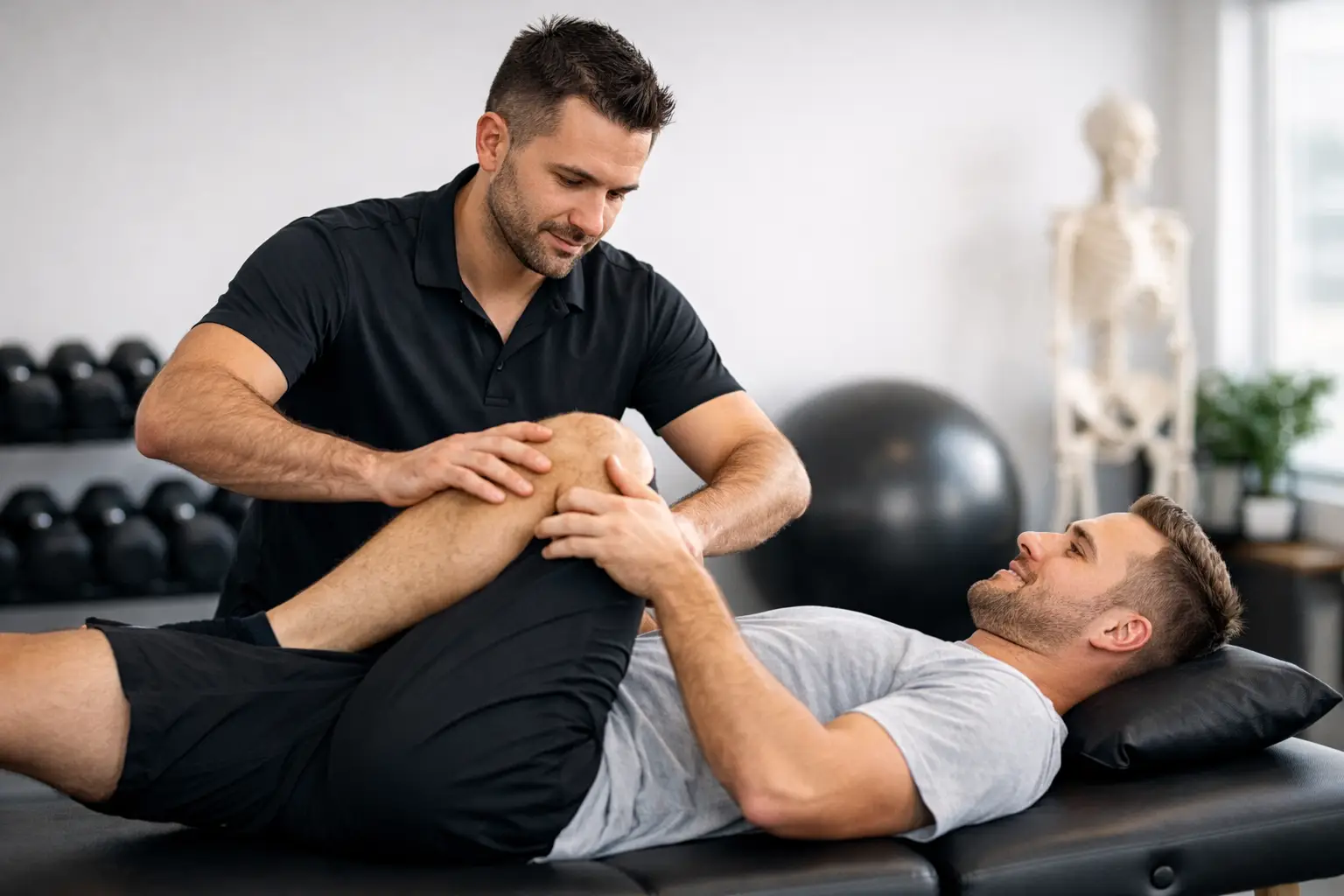
Hands-on care can be a useful part of the process, especially when symptoms are high and movement feels guarded. Soft tissue therapy, joint mobilization, chiropractic treatment, adjustments when appropriate, massage therapy, cupping, shockwave therapy, and Class IV laser therapy can all play a role in helping calm things down and improve tolerance to movement.
But they work best when they support a bigger plan. If treatment helps your hip move better for a short window, that is the time to reinforce the change with the right exercises and strength progressions. Passive care on its own may feel good, but lasting mobility usually comes from combining symptom relief with movement retraining and progressive loading.
That approach is especially important for people who have already tried quick appointments, generic stretches, or repeated treatment without much carryover.
When tight hips are not just tight hips
Sometimes limited hip mobility is a sign that something else needs attention. If you have sharp pinching, persistent pain deep in the groin, major loss of range on one side, or symptoms that keep worsening, it is worth getting assessed instead of guessing. The same goes for people who keep stretching through discomfort and wondering why they are getting nowhere.
There is also a difference between mobility restrictions and irritability. If a position keeps flaring you up, the answer may be to modify load, reduce aggravating volume, and rebuild tolerance gradually rather than push harder into range.
That is where an individualized rehab plan can save a lot of time. A detailed assessment can look at how your hips move, how your spine and pelvis contribute, what your strength baseline looks like, and what your sport, job, or training demands actually require.
A better long-term approach to hip mobility
If you want to know how to improve hip mobility in a way that actually lasts, think less about chasing a stretch and more about building capacity. Improve the range you need. Strengthen it. Use it in patterns that matter to your life and training. Reassess. Progress.
For a desk worker, that may mean breaking up long periods of sitting, restoring extension, and building better single-leg strength. For a lifter, it may mean improving squat mechanics, rotation, and control under load. For a runner, it may mean managing volume, improving hip extension, and addressing frontal plane stability. Same goal, different plan.
At Ground Up Chiropractic & Rehab in Hamilton, that is the difference in approach. It is not just about getting a hip to feel looser for a few hours. It is about figuring out what is limiting your movement, using the right combination of hands-on treatment and rehab, and progressing toward stronger, more confident movement in the gym, at work, and in everyday life.
If your hips always feel stiff, blocked, or unreliable, do not assume you need more stretching. You may need a plan that matches your body, your goals, and the way you actually move.
